Contact
Click below to speak to a Diamond Consultant or customer service.
 1 888-658-6372
or
Live Chat8:00 am - 6:00 pm CST (Mon - Fri)

Click below to speak to a Diamond Consultant or customer service.
1 888-658-6372
or
Live Chat8:00 am - 6:00 pm CST (Mon - Fri)
Diamonds come in a variety of colors, some of them highly prized (pinks, blues, even yellow). However in a white diamond, the presence of a yellow tint will lower the price of a diamond. The less body color in a white diamond, the more true color it will reflect, and thus the greater its value.
Every Lumera Diamond has been assigned a color grade by the GIA in a viewing environment specially designed to eliminate color from surrounding surfaces as well as the light source itself. This allows the color of the diamond to be accurately measured. Minor differences in diamond color detected in this environment are very difficult if not impossible to detect in a normal environment. The diamond industry has adopted the GIA diamond color scale; almost every diamond sold today is rated using the GIA color scale, whether it was actually certified by the GIA or not.
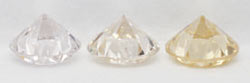
The GIA grades diamonds on a scale of D (colorless) through Z (light color). All D-Z diamonds are considered white, even though they contain varying degrees of color. True fancy colored diamonds (such as yellows, pinks, and blues) are graded on a separate color scale.
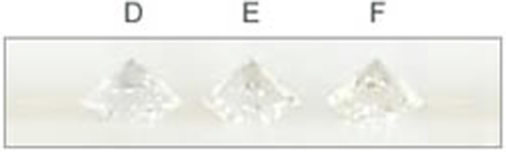
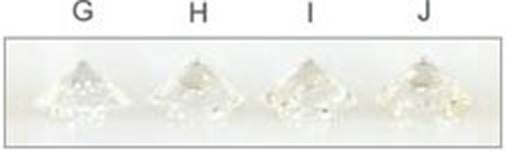
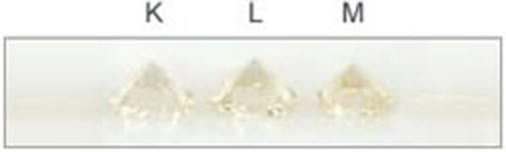
Below is the GIA diamond color chart with definitions, accompanied by further explanatory comments from Lumera:
The photo below shows a master set used by gemologists to grade color in diamonds. Each diamond to be graded is compared to the master set to determine where it should fall on the diamond color scale. The colors you see below are slightly exaggerated, since viewing diamonds face down makes their body color more pronounced. The face down orientation makes the detection of body color easier because brightness and fire are minimized when the diamond is face down.

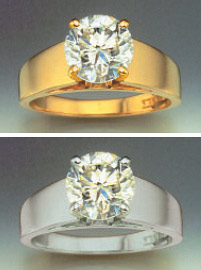
Color becomes much harder to detect once a stone is set in a ring and placed in an environment that contains color (as opposed to the all white background used in diamond color grading). For instance, an H color diamond may look as colorless as a D when set in a ring under normal lighting conditions, especially if the two are not compared side by side.
Another factor that affects a diamonds's apparent color is the color of the mounting itself. Yellow gold makes slight amounts of yellow in a diamond less obvious, while white gold or platinum mountings make the color in yellow diamonds more apparent.
The vast majority of untrained observers (and many gemologists) cannot distinguish a color grade from the one just above or below unless the diamonds are compared side by side in a controlled environment.
Color becomes more important as carat weight increases, because color is easier to perceive in a larger diamond, just as a carafe of white wine shows more color than a single glass.
Questions about color or other aspects of a diamond? Ask a diamond consultant for answers. A consultant will answer any questions you have, and if you like, search for diamonds on your behalf that match your criteria. chat online, or send your request to [email protected].
Choose from our assortment of hand matched Diamond Stud Earrings set in 14k gold.
For the best value in what would appear to the naked eye as a colorless diamond, look for G-J diamonds. Because color is easier to detect in larger diamonds, opt for G-H in diamonds over 1 carat, and I-J for those under 1 carat. Once set in a ring, these diamonds will look just like higher color grade diamonds. Instead of investing in higher color, invest in higher cut, the most important factor in a diamond's brilliance.
Because diamonds with more facets reflect more light, they tend to hide color better than other shapes. So, consider round, princess or other modified brilliant cuts over step cuts such as emerald or asscher if you are concerned about color.
If you are concerned primarily about carat weight, and are on a tight budget, consider a yellow gold setting and a round diamond in the K-L color range. A lower color diamond with a higher cut grade will have more sparkle and visual appeal than a higher color diamond with a lower cut grade.
If, while shopping for a diamond, you are ever given a color range (e.g. G-H) as opposed to a specific grade, the diamond is not certified by GIA. The seller is only estimating the diamond's color using GIA terminology.
Visit the Lumera Diamond Buying Guide for additional tips and advice.
SEARCH FOR A DIAMOND NOW