
Contact
Click below to speak to a Diamond Consultant or customer service.
 1 888-658-6372
or
Live Chat8:00 am - 6:00 pm CST (Mon - Fri)

Click below to speak to a Diamond Consultant or customer service.
1 888-658-6372
or
Live Chat8:00 am - 6:00 pm CST (Mon - Fri)
Because they are formed deep within the earth, under extreme heat and pressure; virtually all diamonds contain "birthmarks"; small imperfections inside the diamond (called inclusions), or on its surface (called blemishes). Clarity refers to the degree to which these imperfections are present. Diamonds which contain numerous or significant inclusions or blemishes have less brilliance because the flaws interfere with the path of light through the diamond.
The position of an inclusion affects how easily it can be seen. Diamond cutters make every effort to cut a stone so that inclusions are not visible through the table of the finished diamond. The preferred position for inclusions is under the bezel facets or near the girdle because they are harder to see there.
Almost all diamonds are graded for clarity using the 11 point diamond clarity scale created by the GIA, including diamonds which were not actually graded by GIA (every Lumera Diamond is GIA certified). In grading diamond clarity, the GIA considers the number, size, color, reflectivity, and position of every flaw visible under 10x magnification.
Below is the GIA diamond clarity chart with definitions, accompanied by further explanatory comments from Lumera:
Questions about clarity or other aspects of a diamond? Ask a diamond consultant for answers. A consultant will answer any questions you have, and if you like, search for diamonds on your behalf that match your criteria. A consultant can personally review a diamond, and give you a report on it's clarity or other details. chat online, or email [email protected].
Because a photograph cannot capture the subtleties of clarity, GIA uses a diamond plot to map a diamond's interior and exterior flaws. A diamond plot is a graphic representation of every flaw that affects the overall clarity grade. The flaws are found under 10x magnification by a skilled grader.
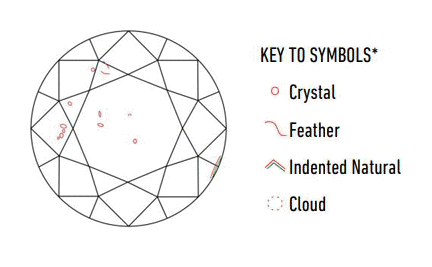
While the plot shows the type and position of each flaw, the actual visibility of the flaw is communicated in the diamond Clarity Grade itself (i.e. two diamonds may have very similar plots, but very different Clarity grades, reflecting the actual severity and visibility of the recorded flaws).
Besides the plot, there is also a comment section on the certificate where additional clarity characteristics are often noted. These are usually too minor to be reflected in the plot itself. Between the plot and the comment section, all inclusions visible under 10x magnification are accounted for.
A diamond plot does not reproduce the actual appearance of a diamond. For SI1 or lower grades, do not assume that a relatively clean plot indicates that there are no flaws visible to the naked eye. Often, a plot may carry only one or two markings, but these are so severe that they warrant a lower overall clarity grade.
By the same token, a cluttered plot may not mean the diamond is visually flawed. The diamond may in fact be flawless to the naked eye, since no single inclusion is severe enough to be seen (even though the cumulative effect of the flaws might warrant a lower clarity grade). When in doubt, speak to a diamond consultant, who will gladly review a diamond on your behalf.
Common inclusions and blemishes, as they are represented on the GIA diamond plot, are illustrated below. GIA uses the color green for surface blemishes, and red for internal inclusions. Sometimes the nature of the inclusion (if it reaches the surface, for example) calls for the use of both green and red. The color black is used to convey extra facets.
The standard GIA Grading Report includes a diamond plot, the abbreviated GIA Dossier (often used for diamonds under 1 carat) does not.
Approximately 1 in 3 diamonds sold has been treated or "enhanced" in some way. A variety of techniques exist to artificially improve the natural clarity of a diamond. By drilling a pathway to an internal inclusion with a laser beam, acid can be poured into the tunnel to bleach the inclusion. The laser tunnel appears as a tiny white dot when viewed from the top of the diamond (where the drilling was performed), but as a long white line when viewed from the side. In addition, fractures in a diamond can be filled with a clear glass-like material, making them less visible. GIA will not certify diamonds which have been fracture filled.
While laser drilling and fracture filling are used to improve a diamond's clarity, high pressure / high temperature (HPHT) treatments are used to improve color by removing brown colorations from the diamond. HPHT involves placing the diamond in a pressure vessel and applying extremely high pressure and temperature. This environment mimics the conditions the diamond crystal was originally formed under. The effects of HPHT are permanent, and the presence of the treatment is very difficult to detect. GIA will certify a HPHT diamond, but will note the presence of the treatment on the diamond's certificate.
Any treatment or "enhancement" made to a diamond lowers its value. Lumera does not sell diamonds that have been treated in any way, including HPHT.
If you cannot tolerate imperfections, even those you cannot see, choose a VVS2 or better diamond. About 10% of all diamonds sold fall into this category.
The most popular range is the VS1-VS2 diamond. These diamonds appear flawless to the naked eye, and are a fraction of the price of a truly flawless diamond. Almost half of all diamonds purchased fall into this range.
The next most popular range is SI1, where the inclusions are usually not significant enough to impact the appearance of the diamond for the casual observer. Often, customers will opt for this clarity range in exchange for a higher cut or color grade. This combination often results in a beautiful, lively diamond with imperfections detectable only upon close inspection. In diamonds under 1 carat, the same can be said for an SI2 grade. In diamonds over 1 carat (where clarity is more important, and SI2 inclusions are often easier to detect), an SI2 is often half the price of a VS1 diamond. About one third of diamonds sold fall into the SI1-SI2 range.
The larger the diamond, the easier imperfections are to detect; therefore Clarity becomes more important. For diamonds over 2 carats, a clarity grade of VS2 or higher is the safest bet for avoiding any signs of visible inclusions. In diamonds between 1 and 2 carats, clarity grades of SI1 or better will not have inclusions easily visible to the naked eye. In diamonds under 1 carat, clarity should be considered the least important of the traditional 4 Cs.
Brilliant-cut diamonds (such as round, princess, cushion, oval, pear, and marquise) hide inclusions better than step cuts (emerald, asscher). When purchasing a step-cut, move up one clarity grade (e.g. purchase a VS2 instead of an SI1 if you desire the lowest grade that has no visible inclusions).
If, while shopping for a diamond, you are ever given a clarity range (e.g. SI1-SI2) as opposed to a specific clarity grade, the diamond is not certified by GIA. The seller is only estimating the diamond's clarity using GIA terminology.
Visit the Lumera Diamond Buying Guide for additional tips and advice.
SEARCH FOR A DIAMOND NOWWith regard to diamonds, “clarity” refers to the degree to which flaws are present in a diamond, both surface blemishes and internal inclusions, visible to the naked eye or not. Generally, flaws not visible at 10x magnification are not considered when assessing the clarity of a diamond.
Anyone can evaluate a diamond for clarity, including the seller of the diamond. However, the preferred route is to have an independent and reputable diamond grading agency, like GIA, evaluate a diamond for clarity. In the case of GIA, the diamond grading is performed by a gemologist, who reviews the diamond under magnification and plots the flaws on a diamond clarity chart. This clarity chart serves as a map of the diamond's blemishes and inclusions, and serves as a type of “fingerprint” of the diamond.
Most labs follow the GIA clarity scale, which grades diamonds from internally flawless (no flaws visible at 10x magnification) to Included (flaws are obvious, even to the naked eye). Elsewhere on this page, you can find a slideshow with a detailed explanation of every diamond clarity grade.
The most popular diamond clarity grade is VS (meaning Very Slightly included). When graded by GIA, a VS1 or VS2 grade is flawless to the eye in almost all cases (although there are exceptions). The SI grades (meaning Slightly included) are also popular as they are often a better value - many GIA graded SI diamonds have no inclusions visible to the eye but carry a lower price point due to the lower clarity grade.
Absolutely. As diamond clarity grades decrease, the visibility of inclusions increases. There are two important things to remember. First: different diamond grading labs have different standards. A diamond that GIA grades as SI1 (slightly included), another lab might grade at VS2 (very slightly included). It is extremely important to make sure the clarity grades you rely on are from a reputable lab.
Second: the severity of inclusions correlates with visibility, but these are not the same thing. For instance, GIA might grade a diamond SI2 because the inclusions are fairly severe. However, if the inclusions are white in color, or positioned very off center table, they may be invisible to the eye. Conversely, GIA might grade a diamond VS2 because there is only a single minor inclusion. But, if the inclusion is dark and concentrated (such as a cloud of poinpoints) near the center surface, it might be visible without magnification.
The higher the diamond clarity grade, the fewer flaws. The fewer flaws, the rarer the diamond. This rarity causes the price-per-carat to increase along with the clarity grade. However, it is important to remember that price and value are not the same. A purchaser may put the same value on a IF (internally flawless) diamond as a VS2 diamond (since they might both be visually flawless); however the price of the VVS1 will be higher despite their identical naked eye appearance.
The answer depends on the meaning of “better”. A higher clarity grade indicates a rarer and more flawless diamond. However, two diamonds might both be visually flawless, and equal in all other aspects of appearance - yet one is graded VS1 and the other VS2. The VS1 is higher in price, and rarer, but some might say the VS2 is “better” in terms of value.
Clarity is one of several aspects of a diamond that impacts price. A diamond might have very good clarity, yet be poorly cut (decreasing light performance) - and therefore priced lower. An effective approach to purchasing any diamond is to determine the lowest grade of cut, color, and clarity that yields the overall desired appearance. From there, choose the price and size combination that best fits your needs.
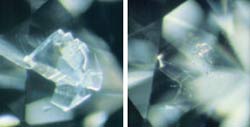
Crystals, pinpoints, and clouds are very common inclusion types noted on the GIA diamond clarity chart. Each has unique causes and characteristics. You can see an example and definition of every common type of inclusion elsewhere on this page.
Typically, an engagement ring wearer wants a diamond with no visible inclusions (or at least, none that are visible on casual inspection). Often, the purchaser will lean towards a higher standard. This is especially true when purchasing online - in an attempt to avoid a visually included diamond, the purchaser will overshoot the mark. Using a Lumera Diamond Consultant is the easiest way to avoid this and other common mistakes.
Clarity is the most important factor when it is under what the wearer expects, but becomes a much less important factor once the desired level of clarity is achieved.
Clarity is of prime importance, up until the point where clarity goals are met. If the desire is for a visually flawless diamond, it is critically important to avoid lower clarity (such as I1 or Si2). However, once visual flawlessness has been achieved, moving still higher on the clarity scale becomes much less important than achieving the desired cut, color or carat weight.
Yes, it can. There are various treatments that can be applied to a diamond, such as HPHT (high pressure high temperature) or laser drilling. Lumera does not offer diamonds with these types of artificial enhancements.
If a diamond is severely flawed, such as I2 or I3 clarity, then the stability or durability of the diamond can be impacted. Depending on the type and position of the inclusion, the diamond may be prone to splitting or chipping. The vast majority of diamonds sold are Si2 or higher, clarity grades which have no adverse impact on the diamond’s structural integrity.
