
Contact
Click below to speak to a Diamond Consultant or customer service.
 1 888-658-6372
or
Live Chat8:00 am - 6:00 pm CST (Mon - Fri)

Click below to speak to a Diamond Consultant or customer service.
1 888-658-6372
or
Live Chat8:00 am - 6:00 pm CST (Mon - Fri)
Diamonds are sold by the carat (shown as ct.), which is actually a unit of weight, though most think of a carat in terms of size. The word "carat" comes from the "carob" seed, the original unit of measure for diamond traders. Today, a carat is equal to exactly 0.2 grams (about the weight of a paper clip). Carat weight is unrelated to the similar sounding karat, which refers to gold's purity. (Learn more about precious metals)
Two diamonds of equal carat weight can have very different costs based on other factors (such as cut, color, and clarity). In understanding the importance of carat weight, know thy partner. If the recipient's heart is set on a certain size diamond, then carat weight will probably be the most important factor in your search until the desired size is attained. At that point, other criteria will take on more importance. Most women can tell you the carat weight and shape of their ideal diamond, and most men can tell you the price.
As the carat size of a diamond increases, the diamond's price increases at an increasing rate. Why? Because the larger the diamond, the more increasingly rare it is. Fewer than one in one million mined rough stones are large enough to produce a finished 1 carat diamond. So, as carat weight increases, you will typically pay more not only in total, but on a price-per-carat basis as well. The table below illustrates the typical relationship between diamonds of equal quality and increasing carat weights:
| Carat Weight | 1.00 | 2.00 | 3.00 |
|---|---|---|---|
| Price-per-carat | $ 6,000 | $ 12,000 | $ 18,000 |
| Total Price | $ 6,000 | $ 24,000 | $ 54,000 |
Every Lumera Diamond includes the price-per-carat so you can easily compare diamonds of various carat weights.
SEARCH FOR A DIAMOND NOWEven though the price of a diamond increases exponentially with the carat weight, the actual size does not. The table below illustrates the typical size relationship between diamonds of increasing carat weights. Note that when carat weight triples (from 1 to 3 carats), perceived size (represented in the images below) roughly triples as well, however the diameter increases only 45% (from 6.50 to 9.40), and crown area (the surface area visible when the diamond is set) slightly more than doubles.
| Carat Weight | 1.00 | 2.00 | 3.00 |
|---|---|---|---|
| Approximate Size |

|

|

|
| Diameter (mm) | 6.50 | 8.20 | 9.40 |
| Crown (mm2) | 33.2 | 52.8 | 69.4 |
This is important to keep in mind when reviewing diamonds of any shape; a given increase in diameter will yield a larger increase in surface (crown) area and overall perceived size. While the third diamond above has a roughly 50% greater diameter than the first, it certainly appears more than 50% larger.
When viewing diamonds on Lumera, check the measurements listed for each diamond to understand its size. The length and width will tell you exactly how large the diamond will appear when viewed from above.
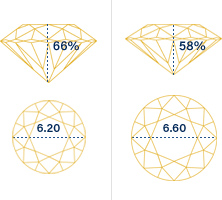
Two diamonds of the same shape and carat weight may still appear different in size based on the cut proportions. A deeply cut diamond has a greater proportion of its total weight "hidden" in the depth, resulting in a smaller diameter than a well cut diamond. These differences are usually small, but noticable. A well cut diamond may even have a slightly lower carat weight than a deeply cut diamond, yet still have a larger diameter, making it appear larger in size.
Two diamonds of equal carat weight may also appear very different in size based on the shape of the diamond. For instance, a 1 carat marquise tends to appear larger than a 1 carat round. The chart below illustrates why. For each diamond, the chart shows the following:
Remember that while the measurements below are typical, every diamond is unique.
| Size |

|

|

|

|

|

|

|

|

|

|
|---|---|---|---|---|---|---|---|---|---|---|
|
Length
x Width |
6.50
x 6.50 |
5.58
x 5.46 |
7.76
x 5.69 |
10.18
x 5.33 |
8.67
x 5.66 |
6.12
x 5.69 |
6.57
x 5.09 |
5.68
x 5.60 |
6.35
x 5.39 |
6.14
x 6.89 |
| Crown (mm2) | 33.2 | 30.2 | 33.3 | 36.9 | 34.0 | 29.2 | 31.8 | 28.7 | 32.1 | 28.1 |
To see the actual size of each diamond shape at various carat weights, print the diamond carat size chart below:

Print a copy of our complimentary diamond size chart to see the actual sizes of diamonds of various shapes.
PRINT SIZE CHART(Requires Adobe Acrobat Reader. Download it here for free.)
Questions about carat weight or other aspects of a diamond? Ask a diamond consultant for answers. A consultant will answer any questions you have, and if you like, search for diamonds on your behalf that match your criteria. chat online, or send your request to [email protected].
Look for diamonds that fall just under popular carat weights such as 1/2 ct. 3/4 ct., 1 ct., etc. Because these diamonds fall just shy of the popular weight, they are often sold at a slight discount compared to diamonds of full weight. For example, a .90 carat diamond will typically cost less on a price-per-carat basis than a full 1.00 carat diamond. Visually, they are difficult to distinguish. In fact, a smaller carat weight diamond may have a diameter equal to that of a heavier diamond, making it appear the same carat size when viewed from above.
Visit the Lumera Diamond Buying Guide for additional tips and advice.
SEARCH FOR A DIAMOND NOW